All products made in the biotechnology industry have an impact on our society, politics, and the economy, no matter how big or small. The hepatitis B vaccine is no different. Being one of most used vaccines ever, the hepatitis B vaccine has woven itself into our culture. From any viewpoint, the vaccine has affected all of us, whether we know it or not.
Social Impacts To most people born after the first production of the vaccine, needles have become a norm in life, something that everyone has to get.Ever since the hepatitis B vaccine was first produced, it has become very common among the long list vaccines given to babies at birth. Many countries, including the United State, Canada, England, and France, have made the vaccine part of their yearly medical immunization schedules. ("Immunization: Hepatitis B") Consequently, the number of children and adolescents infected per year has dropped dramatically from 260,000 in the 1980s to approximately 43,000 in 2007. ("The Hepatitis B Vaccine") In the rare cases of significant vaccine side-effects or seemingly outrageous congressional bills (such as the "Protecting America in the War of Terror Act of 2005"), social uproars and even lawsuits have rocked the country. Especially when new studies came out concerning thimerosal (a preservative formerly contained in the hepatitis B vaccine) and links to autism at the turn of the 21st century, media, concerned parents, and doctors have voiced their fears about the safety of the vaccine. |  In countries with higher frequencies of hepatitis B, such as China, the vaccine has become absolutely mandatory. In China, it is almost impossible for anyone, no matter how healthy or well-educated, to get a job without being immunized against hepatitis B. Although the Chinese government has stepped in and now allows hepatitis B carriers to join public service, it is very difficult to enforce such laws. Unfortunately, discrimination against hepatitis B carriers (who cannot be immunized since they already have the disease) continues. ("Hep B Carriers") |
Economical Impacts Immediately after the rDNA (recombinant DNA) vaccine was made in Blumberg's lab, many biotechnology companies around the world competed to manufacture the first commercially available hepatitis B vaccine. As Merck & Co, Inc. added the hepatitis B vaccine to their repertoire of products, other biotechnology companies sprung up, especially in Asian countries (China, Korea, and India) where hepatitis B is extremely common. However, in developing countries with very low incomes, affording to import and give hepatitis B vaccines to children is already very difficult, let alone start a company. (Kim, "Economic Evaluation") As organization such as the Global Alliance for Vaccines and Immunizations (GAVI) push for worldwide hepatitis B immunizations, some countries like Gambia have tried to give vaccines to as many children as possible without leaving a hole in their budget. For most developing countries, money for vaccination programs come from donations and large international organizations, but long-term funding is limited and solely depends on the countries' financial progress. |
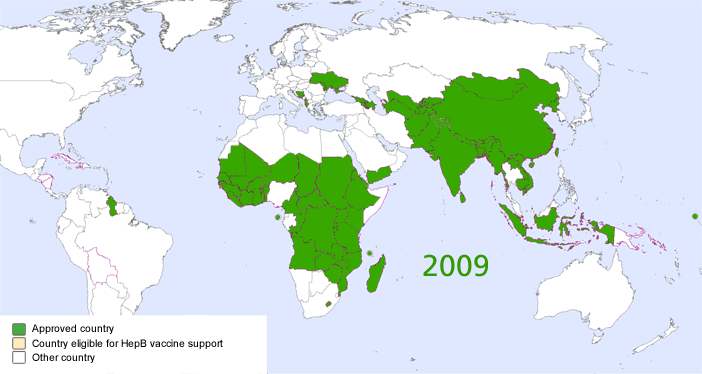 Countries funded by the Global Alliance for Vaccines and Immunizations (GAVI) as of 2009 |
Political Impact
In the United States, the Hepatitis B vaccine is mandatory for all newborns. However, state governments still have the right to ban certain chemicals in vaccines that they feel are unsafe.
As more research on thimerosal, a preservative formerly used in the hepatitis B vaccine and other vaccines, showed that the mercury it contained could cause autism and even death, state lawmakers began putting together bills to ban mercury in vaccines. In 2004, Iowa became the first state to ban mercury in vaccines. Soon after, California governor Arnold Swcharzenneger signed his state's ban on mercury while other states followed the lead.
The next year, a new Senate bill, called the "Protecting America in the War of Terror Act of 2005", was proposed by Republican Judd Gregg of New Hampshire. This bill would overturn all state bans and prevent state governments from providing different health information to their residents besides what was provided by the federal government. Sponsors of the bill promoted it as a "military veteran benefit bill" since it would raise death benefits for families of soldiers in Iraq. (Reagan, "A Dragon") However, this bill did not pass and is therefore not currently law. ("S.3 [109th]")
