Biotech Innovators Countless biotechnology companies, universities, and research facilities all around the world have tediously studied hepatitis B in hope of coming up with improvements to previous discoveries and/or new medications and treatments. Over the years, while battling competition, time, and sometimes even criticism, a few companies and universities have made ground-breaking advancements in preventing and curing hepatitis B. |
||||
Merck & Co, Inc. Out of the growing amount of biotechnology companies involved in making hepatitis B products, one company-the first to produce the DNA Recombinant vaccine-stands out. Merck & Co., Inc, an American biotechnology company based in New Jersey, is famous world-wide for advances in treating and preventing all sorts of diseases. Merck's vaccine, Recombivax HB, is one of the most frequently used hepatitis B vaccine in the United States. Being the oldest vaccines used does not mean Recombivax HB is in any way out-dated; after concern about the presence of thimerosal (a preservative), Merck was again among the first to alter the vaccine so thimerosal would not be needed. 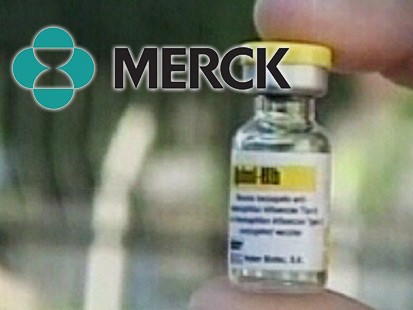 |
Arizona State University Biodesign Institute Charles J. Arntzen, the director of Arizona State's Biodesign Institute, led a study on making oral hepatitis B vaccines from potatoes. Although immunization is highly recommended in many countries, only about 40% of the world's children are vaccinated due to barriers such as cost, delivery, and lack of professional medical workers. Non-refrigerated vaccines would help cut down on costs for delivery and overall efficiency, not to mention a less scary immunization for children around the world! During their experiment, Arntzen and his team genetically modified potatoes to produce HbsAg, the same hepatitis B protein that is in traditional vaccines. Out of the forty-two volunteers who had eaten bite-sized pieces of the raw potatoes, 60% showed signs of immunization. The next challenge that faced Arntzen and his team was how to make the vaccine into some sort of nonperishable pill. After freeze-drying and grinding the potatoes into a powder, they carefully measured the powder into gelatin capsules. Arntzen hopes that this method can also be used for other diseases, such as measles and malaria. (Reinberg, "Genetically Modified Potato") Below: Arntzen and a coworker in their greenhouse.  |
GlaxoSmithKline In 2007, GlaxoSmithKline, an European biotechnology company, produced a new hepatitis B vaccine, FENDrix, for people with renal insufficiency (kidney problems, including hemodialysis patients). This vaccine was produced using a completely new adjuvant system (compounds that help the vaccine's antigen elicit a certain immune response from the body). The Adjuvant system (A0S4, which contains an immune stimulator) also extends the amount of time the vaccine is effective. FENDrix is the first vaccine containing A0S4 to be approved by the Food and Drug Administration (FDA). Below: A vaccine bottle with adjuvant system. 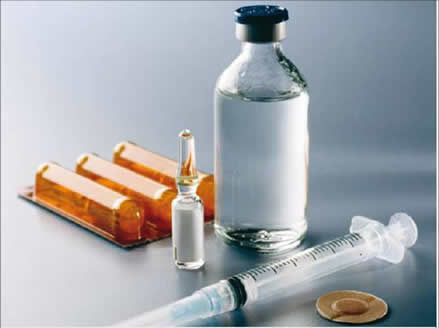 |
||
